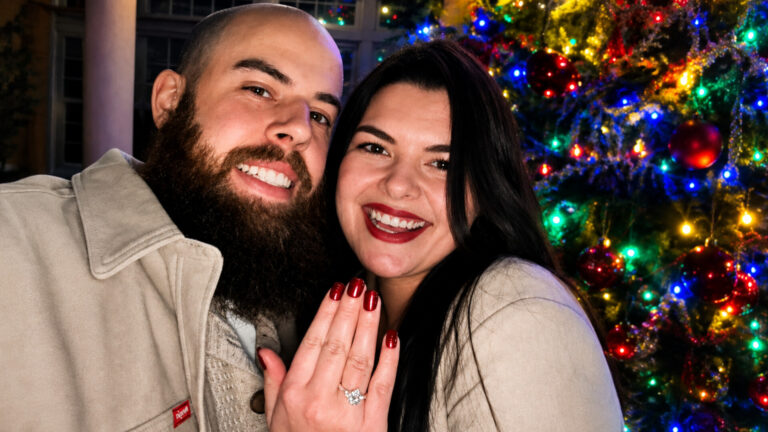
This couple married after a college romance only to find they were a ‘holiday romance’ at age six

The statistical odds of finding your soulmate in a crowded dormitory are slim, but the odds of marrying your first crush from two decades prior are astronomical. Most people view their early childhood infatuations as fleeting, forgettable moments lost to the haze of youth. Yet, a British couple discovered that their modern-day marriage was actually the second chapter of a story that started on a Mediterranean beach.

Heidi and Ed Savitt, both 26 years old at the time of their revelation in 2017, appeared to be a standard success story of university romance. They met in 2011 while attending Newcastle University in the United Kingdom. Their initial interaction was purely practical: Ed had moved into a student flat previously occupied by Heidi. Confused by the mechanics of a finicky tumble dryer, he noticed Heidi’s name on a piece of leftover mail and messaged her to ask for help.

That digital icebreaker led to a first date, which quickly evolved into an inseparable bond. For years, the couple believed their origin story was a charming product of college housing coincidences. They progressed through graduation, entered the workforce, and eventually walked down the aisle to exchange vows during the summer of 2017. It was only after the wedding, during a casual family dinner, that the foundations of their history shifted.

While dining with their mothers, the conversation drifted toward Heidi’s early childhood. Her mother, Kay Parker, reminisced about an overseas trip to Gumbet, Turkey, when Heidi was just six years old. Kay mentioned that Heidi had spent the entire two-week vacation attached at the hip to a young boy she called her “holiday boyfriend.” The two children were reportedly so Smitten that they held hands for nearly the entire duration of the trip.

While the name “Ed” was mentioned, the family initially dismissed it as a quirky coincidence. After all, Ed is a common name, and thousands of British families flock to Turkish resorts every summer. The dinner ended, and the anecdote likely would have been forgotten if Kay hadn’t decided to venture into her attic a few weeks later.

Buried in the rafters of her home, Kay unearthed a dusty photo album labeled with the year 1997. As she flipped through the film-developed snapshots of the Turkey trip, she stopped at a photo of six-year-old Heidi standing next to a blond boy. The boy’s face was unmistakable. It wasn’t just a child who shared her son-in-law’s name; it was the exact same person.

Kay immediately contacted Ed’s mother, Fiona, who searched her own archives to find matching photos of the same two-week window. The evidence was undeniable. The newlyweds, who thought they had met via a broken laundry appliance in their twenties, had actually spent their formative years building sandcastles and holding hands in a different country.

This phenomenon is often discussed in psychology as “cryptomnesia” or hidden memory, where an individual recalls a forgotten memory but believes it to be a new, original thought. While the Savitts did not consciously remember each other, Heidi later wondered if a “subconscious realization” played a role in their instant connection at university. They felt an immediate familiarity that neither could quite explain at the time.

Human interest stories like these often touch on the concept of “Invisible String Theory,” a popular cultural trope suggesting that two people destined to be together are connected by an unseen thread that tangles but never breaks. Research into social networks often highlights the “Small World” phenomenon, suggesting that we are all connected by roughly six degrees of separation. However, the Savitt case reduces those degrees to zero, spanning two decades and thousands of miles.

The discovery sent shockwaves through their social circles, with the childhood photos quickly going viral. Friends and family were captivated by the visual proof of a twenty-year gap between their first and second “first date.” For Heidi, the most chilling thought wasn’t that they had met before, but that they might have lived their entire lives without ever realizing it.

If Kay had never climbed into that attic, or if those specific rolls of film had been lost during a house move, the Savitts would have remained oblivious to their shared past. They would have continued their lives believing they were strangers until college. Instead, they now possess a rare kind of romantic validation—a photographic record that, for them, the universe had made its choice before they even knew how to read.

Source: https://nypost.com/2017/12/26/newlyweds-discover-they-were-childhood-sweethearts/

Similar Posts