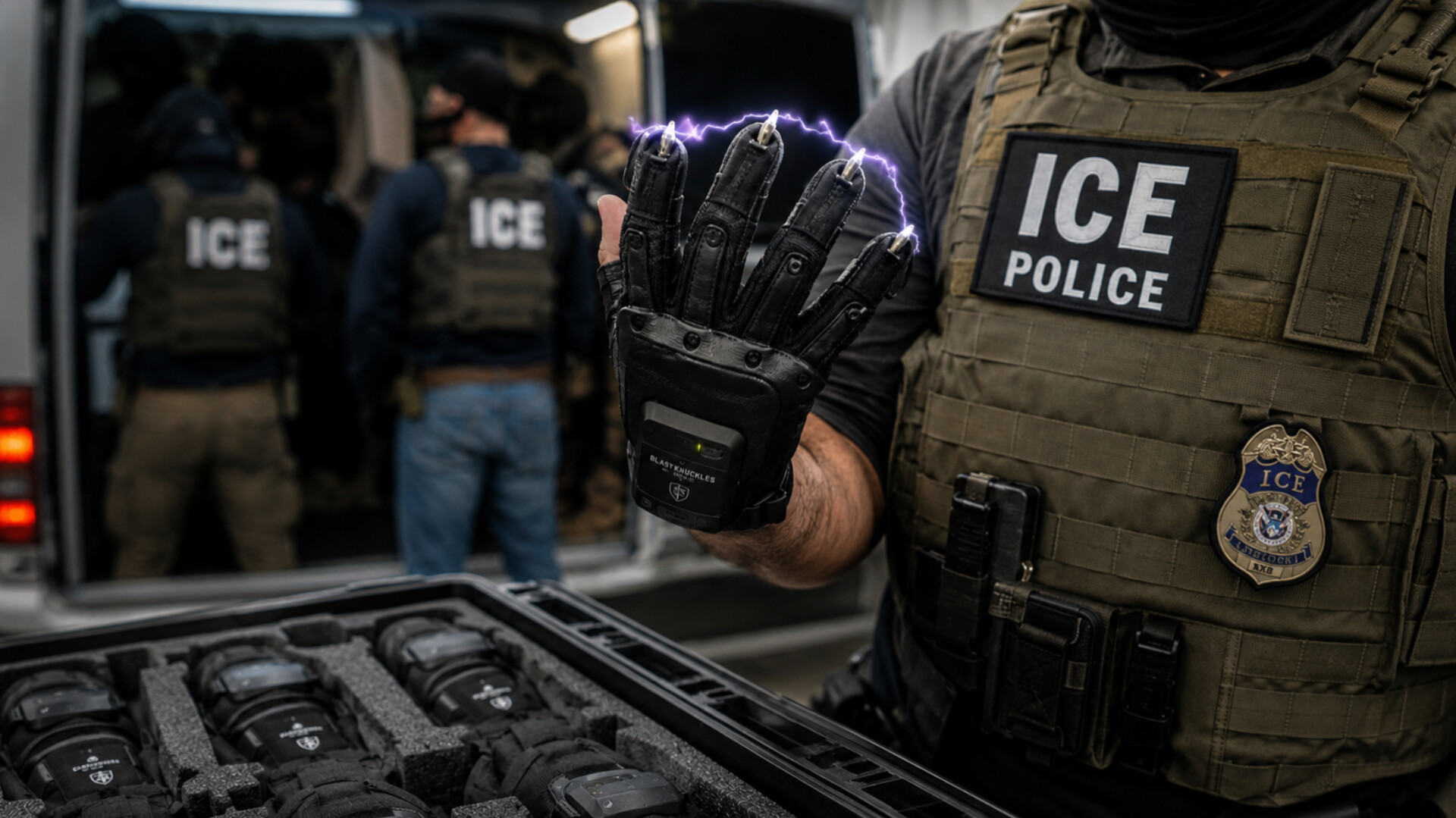
ICE AWARDED $16.7M CONTRACT FOR ELECTRIC SHOCK GLOVES
ICE shock gloves now come with a $16.7 million price tag, and lawmakers want the deal canceled.
On August 10, 2026, the Department of Homeland Security published a notice saying ICE needed to buy CTG-5 G.L.O.V.E. devices, short for Generated Low Output Voltage Emitter, for officers and agents in Homeland Security Investigations and Enforcement Removal Operations.
DHS called the gloves “a Conductive Distraction and De-escalation Device,” Reuters reported.
The DHS acquisition forecast classified the purchase as a firm-fixed-price contract and listed “NO” for competition.
What the gloves do
BBC reported that the gloves can deliver up to 380 volts. A standard U.S. power outlet carries 120.
An officer presses a button, and the gloves can fire up to 30 pulses per second. The shock only comes through direct contact with skin, so an officer can touch clothing without zapping anyone and then make contact with skin. Built-in microprocessors record each activation.
Lt. Butch Gallion, an administrator at the Hawkins County jail in Tennessee, described the gloves’ compliance approach as “pain deterrence.”
The manufacturer’s manual recommends avoiding use on elderly people, small children, pregnant women and people it describes as “severely handicapped.” It also recommends that a second officer be present to restrain the subject.
Compliant Technologies said the gloves do not cause injury and are used by many agencies.
What happened next
On August 27, 2026, ICE awarded Compliant Technologies, a Kentucky-based company, a no-bid contract for 6,000 pairs of gloves, Reuters reported. The deal also covers support equipment and services over six months.
The final price came in at $16.7 million. The earlier DHS forecast had put the purchase in a range with a higher ceiling, but that figure was never the contract price.
Sixteen senators called on ICE to cancel the order and asked for answers on safety, use protocols and accountability, according to Sen. Reed’s office.
On September 3, 2026, Reps. Dean and Ramirez introduced “The No Shock Act.” The bill would bar the gloves from DHS immigration enforcement, including ICE, HSI and state and local officers enlisted for federal immigration work.
On October 7, 2026, CNN reported that the contract requires delivery within six months. White House border czar Tom Homan said it could “be a while” before the gloves are in use while ICE works through training and policy issues.
CNN also reported that records obtained by American Oversight and shared with AP showed ICE leaders knew of an Army study before they signed the contract. In that study, participants in a military exercise felt intense pain, stopped fighting immediately and feared further exposure.