A 17-YEAR-OLD IS ENGINEERING TOMATOES TO TASTE LIKE BURGERS
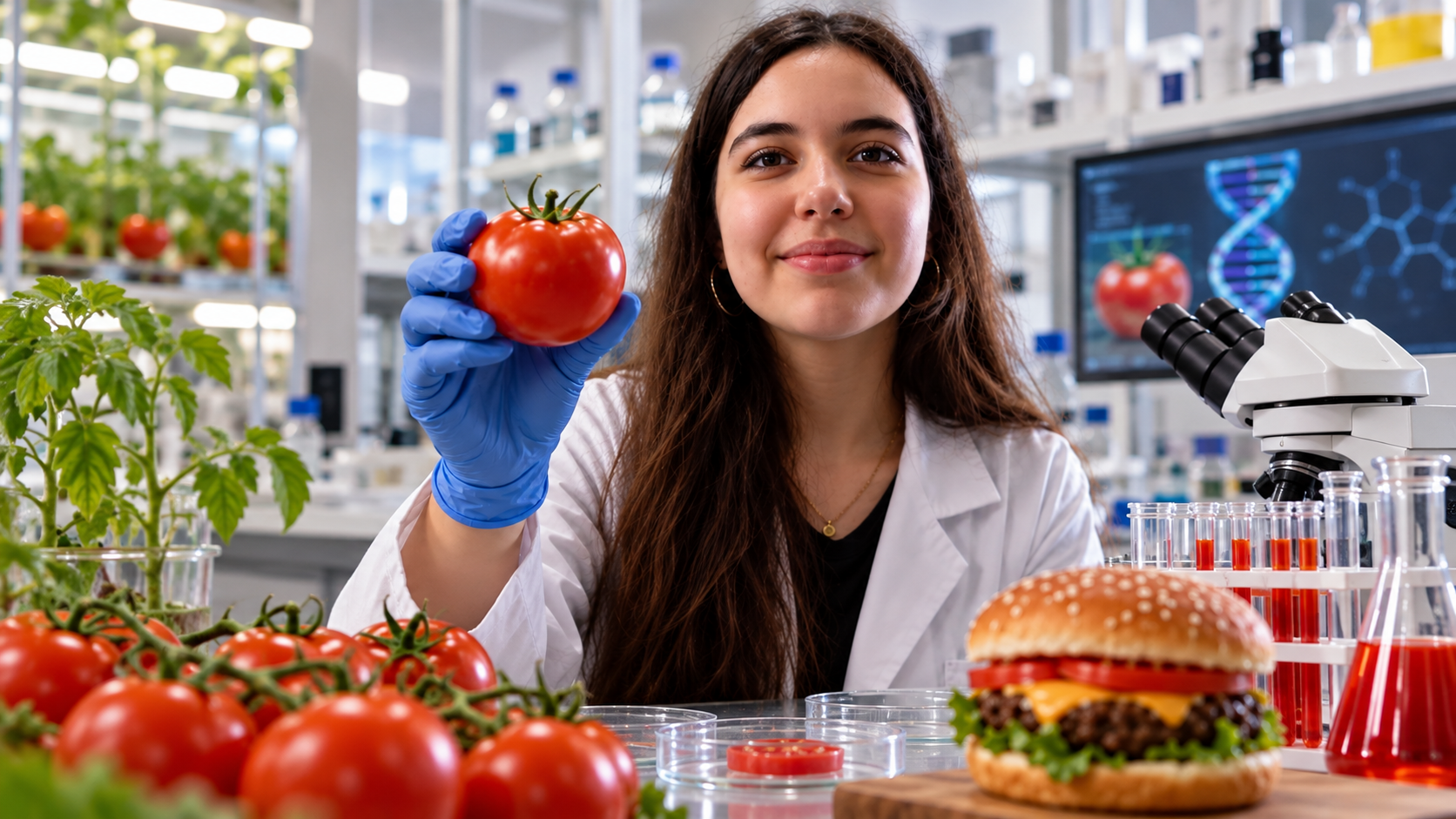
Gabriella Rothberg, a 17-year-old senior at Ransom Everglades High School in Miami, is genetically engineering tomato plants to make heme, the iron-containing molecule that contributes to meat flavor, through a project called Impossible Vines. The idea started when she was 15 and wondered, while making her father a sandwich, whether vegetables could taste like meat without being processed into meat substitutes.
“You’ll bite into a tomato, and it’ll taste like a hamburger,” Rothberg told Miami New Times.

She is working on it with Maddison Marshall, a University of Miami PhD candidate. They use Agrobacterium, a bacterium scientists commonly use to move genetic material into plants. “We’re choosing which gene we want to integrate so this plant can produce the natural proteins,” Rothberg said.
Impossible Foods gets its meaty flavor from soy leghemoglobin made by genetically engineered yeast. Rothberg wants a tomato that makes a heme-containing protein on its own.
Science runs in the family. Yahoo Tech reported that her father, Jonathan Rothberg, received the National Medal of Technology and Innovation for next-generation DNA sequencing technology, and that her mother is a physician and cancer researcher. “When most families talked about sports at the dinner table, my parents talked about evolution, astronomy, and physics,” Rothberg told New Times.
The project is more than a school experiment. A U.S. patent issued in June 2026 lists Rothberg and her father as inventors, with Impossible Vines Inc. as the assignee.
She also leaned on artificial intelligence. “AI has helped me construct a business plan. AI has helped me construct a patent. AI has helped me build the constructs for this heme gene that I want to integrate into the tomato plant,” she said.
The early going was slow. For months the plants did not grow as expected, until the team learned the vitamin concentration in their growth medium was off. Once they fixed it, growth they had waited months for showed up within weeks. “Now we’re moving as fast as ever,” Rothberg said.
Her goals go beyond a vegan burger swap. She told People the tomatoes could improve access to nutrients where meat is less available, with pregnant women in countries in the Global South among those who could benefit. The impact, she said, depends on whether the tomatoes can contain enough absorbable iron.
She may also try to boost the tomato’s natural lycopene, which has been studied for a possible role in lowering cancer risk, though research has not established that eating more of it prevents cancer. “A tomato a day keeps the oncologist away, you know,” she told New Times.
On October 12, 2026, Rothberg posted that a plant that began as a tissue-cultured explant in June had become an established plant. “From a tiny leaf on a petri dish, we grew stem cells, shoots, and finally roots,” she wrote.
Then on October 29, 2026, The Miami Hurricane reported that Impossible Vines had produced a transformed plant and that the team was testing it. Rothberg told the paper she hopes the tomatoes could one day be available on an ordinary grocery run.