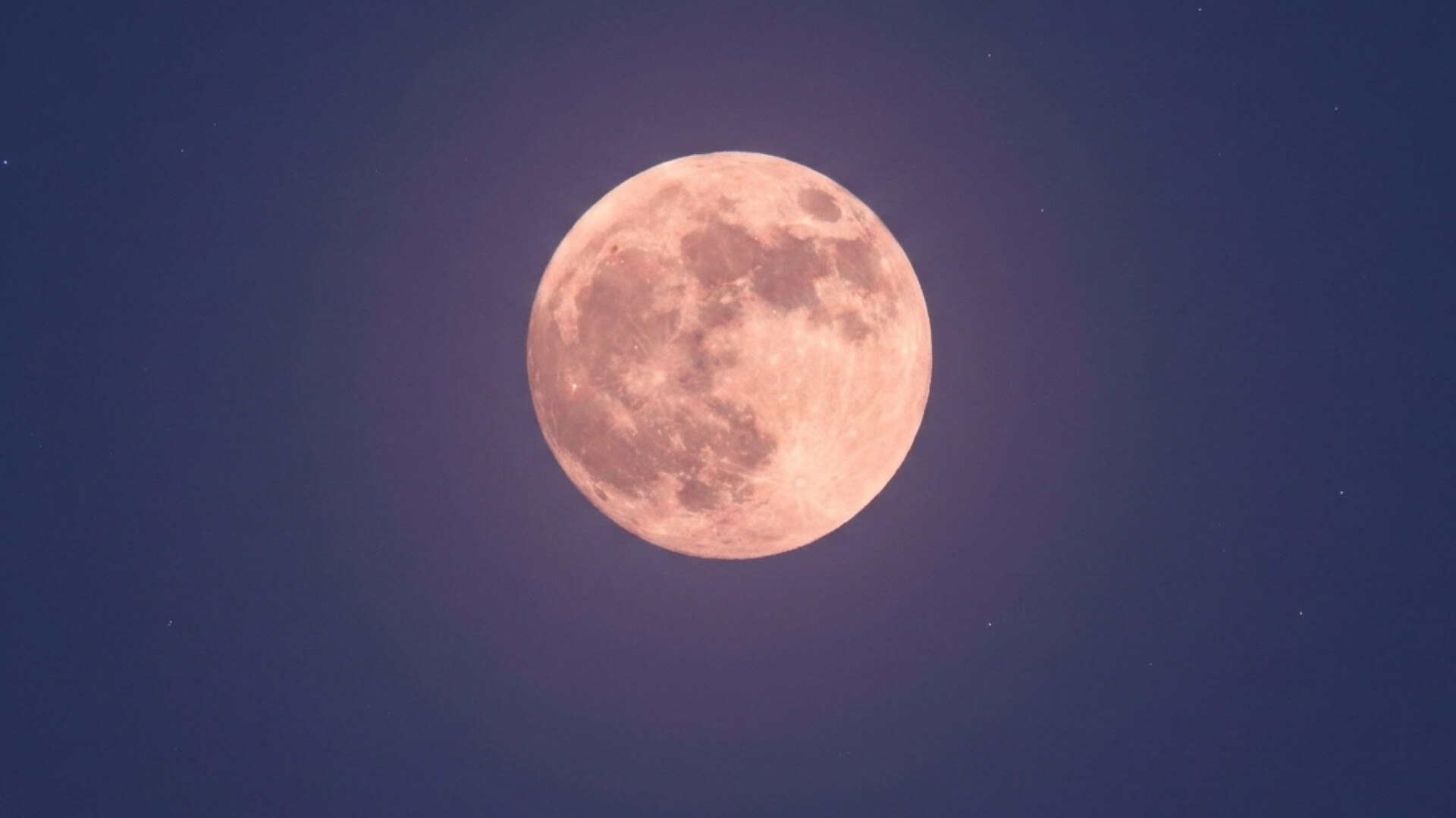
JUNE’S STRAWBERRY MOON WAS THE LOWEST FULL MOON OF 2026
June’s Strawberry Moon, the first full moon of summer, reached its full phase at 7:57 p.m. EDT on June 29, 2026, and it was the lowest-hanging full moon of the year. That is because it landed close to the June 21 summer solstice, and a full moon always takes the opposite path across the sky from the Sun.
Space.com reported the timing, and Astronomy.com listed the same minute. The Moon looked bright and round for a night or two on either side of that moment, so nobody who missed the exact minute was left out.
A low, small and slightly golden moon
The solstice marks the Sun’s highest point in the Northern Hemisphere’s daytime sky. A full moon nearby has to take the opposite, low route, tracing the year’s shallowest arc.
“During the summer, the moon is at its lowest declination and closest to the horizon,” Paul Ricketts, interpretive specialist and director of the Willard Eccles Astronomy Observatory, said in a University of Utah article.
EarthSky said the path was among the lowest in decades in the Northern Hemisphere. The Southern Hemisphere got the reverse, one of its highest full moons in decades.
Space.com advised looking east shortly after sunset to watch the Moon climb among the stars of Sagittarius. EarthSky said the June full moon points roughly toward the center of the Milky Way, near the Teapot asterism, though the Moon’s brightness overpowered the Teapot’s stars. Moonrise times varied by city, so viewers had to look up their own.
Ricketts said Salt Lake City viewers might have to wait if mountains blocked the view. The same mountains could help, he said, because the Moon would first appear higher, through less atmosphere.
Despite the name, the Moon did not turn pink, Space.com said. It could look golden or orange near the horizon, because moonlight passing through more of Earth’s atmosphere has its shorter wavelengths scattered away, leaving the warmer colors.
“The lower it is, the redder it is,” Ricketts said.
Space.com also pointed to the moon illusion, which can make the Moon look bigger beside distant landscape features. It is a trick of perception, and the Moon’s size does not change.
Where the name came from
The “Strawberry Moon” name is linked to the short strawberry harvesting season traditionally observed by Native American tribes, Space.com said. Astronomy.com, citing NASA for the name’s origin, put it plainly: “The June Full Moon is also called the Strawberry Moon.” EarthSky noted that Northern Hemisphere strawberries can ripen anywhere from April through June depending on climate and variety.
Space.com said June’s full moon also goes by Rose Moon, Hot Moon and Mead Moon.
Also a little on the small side
The low moon was also a small one. Live Science reported it was the second-smallest full moon of 2026, at 252,442 miles from Earth. The Blue Moon before it sat just 63 miles farther out.
Timeanddate gave a slightly different figure, 405,254 kilometers (251,813 miles) at full phase, and called it a micro full moon. It said a micromoon may appear 6 to 7 percent smaller than an average full Moon, though the difference is hard to notice.
No special gear was needed to watch. Binoculars or a backyard telescope could bring out craters and mountains, Live Science said.
Space.com’s editor’s note afterward said the Strawberry Moon “certainly served up quite the treat” and pointed readers to a gallery of skywatcher photos from around the world.
EarthSky still describes the June full moon as the year’s lowest-hanging and as a micromoon, the last of three full micromoons in a row in 2026.